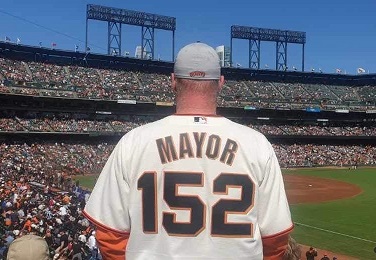

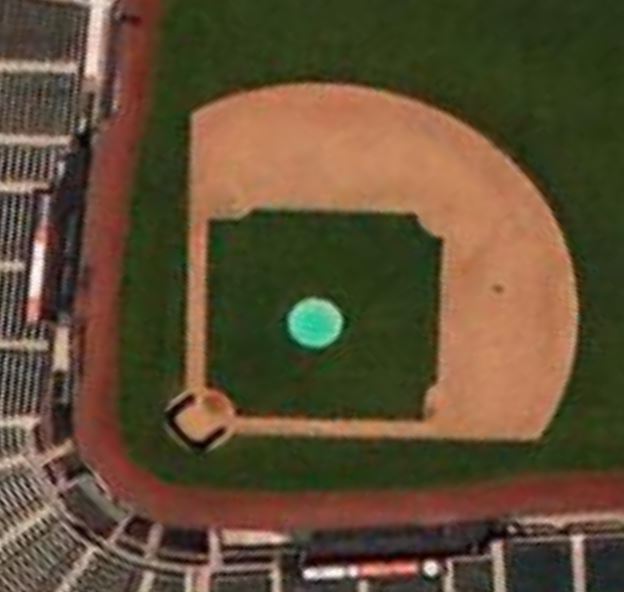
It’s Martin’s first time at a baseball game, but he’s not new to sports. In fact, I think he is more of a sport guy than I am. He’s been in the US for about two months, although it’s not his first time here. He has spent a while working as a sportswriter and occasional broadcaster covering the NBA for German outlets, which is very intimidating given that I have been writing down stories for a month now with an audience of mostly family, people I have dated, and robots that subscribe to every blog on WordPress. Once or twice he refers to the two of us as ‘journalists,’ which is true in the same sense that Katrina Lehis and I are both fencers. He says right at the beginning of the game that I should feel free to load him up with information about baseball, that he’d love to hear anything about strategy and tactics that I have to offer, which is even more intimidation, since my idea of good information about baseball tactics is that stealing first base after you’ve already reached second wasn’t officially outlawed until 1919. I decide to let him ask questions, and he immediately stumps me by asking why there is a crescent-shaped cutout instead of a corner. At the end of the night, I still haven’t come up with a good explanation, and just before we part ways on the BART ride home, he urges me – as one journalist to another – to find the answer to the most important question.
We spend about equal amounts of time talking about basketball and baseball, with some added comparisons to soccer, football, and a little bit of hockey. Also, I find out that in Germany, handball is a pretty big thing; Martin assures me that it’s not like it is here, which I would have assumed, because what I know as handball is barely interesting enough to keep the players interested, let alone a crowd of 20,000. When I look up ‘german handball highlights’ later on Youtube, the results are startling – it looks like a multiplayer version of college-level tag mixed with dodgeball if the object of dodgeball were to frighten your opponents instead of hit them, but run at double speed. I can see, if this version of handball is what he grew up with, how basketball was the American sport he gravitated to – it’s constant action and what looks like insane athleticism. His basketball team is the Dallas Mavericks, at least partially due to fellow German Dirk Nowitzki’s tenure there, which – as a member of a family that latched onto whatever Danish or Irish public figure that came along – I can get behind.
Martin is a wellspring of fascinating conversation; we do eventually get into some baseball questions I can answer, about the ways to get runners out on the basepaths – tagging as opposed to force-outs – and sacrifice flies, and situations where a pitcher might walk a hitter on purpose, but the most interesting part of the conversation for me is about how sports – and how people appreciate and participate in fandom – are different in Europe. For one thing, he points out that the longest season he can think of is the Bundesliga soccer season, which lasts for 34 games. Each of the 18 teams plays 17 home and away games, and they all take place on the weekends, which means that fans can focus in a way that we just don’t here. At least baseball and basketball fans can’t, given the sheer number of games and the constant every-day schedule. NFL fans might be able to, but they don’t; we don’t have the kind of coordinated crowd efforts – songs and cheers and traditions that involve entire venues full of people all working together. I kind of wish we did, if only to do away with our anemic waves and “What’s the matter with (nearest available outfielder’s name here)/He’s a bum” and so on.
At the end of the evening, on the way out, I mention to Martin my feelings about the ballpark as an oasis of peace and calm when the sun has gone down, and ask if there’s anything about the particular dynamic of a basketball arena that speaks to him; he has similar feelings about an empty gym, but talks more about the difference between the constant hustle of an NBA game, with points on the board very twenty seconds, and the slower pace of baseball or soccer, where a game might have two or three crucial turning points – runs scored or a timely double play (both of which the Giants manage tonight, ending up with an exciting 6-4 win over the Brewers). On the walk out of the park, he asks if I’d be interested in a basketball game sometime. We’re at the point right now where any basketball game we could get to this season would involve several hundred dollars, several hundred miles of travel, or both, but yeah – I would definitely go to a basketball game with Martin.
 81 Dates